Multi-participant decisions
Three participants contribute to each decision. Each contribution is individually attributed, with provenance classification distinguishing what the model produced from what the scenario defined.
RESEARCH / AID
The AID is a working research prototype from the Continuity project. It shows how multi-participant AI decisions can be recorded with individual attribution, checked for tampering through replay, and presented through a read-only interface that cannot modify the records it displays.
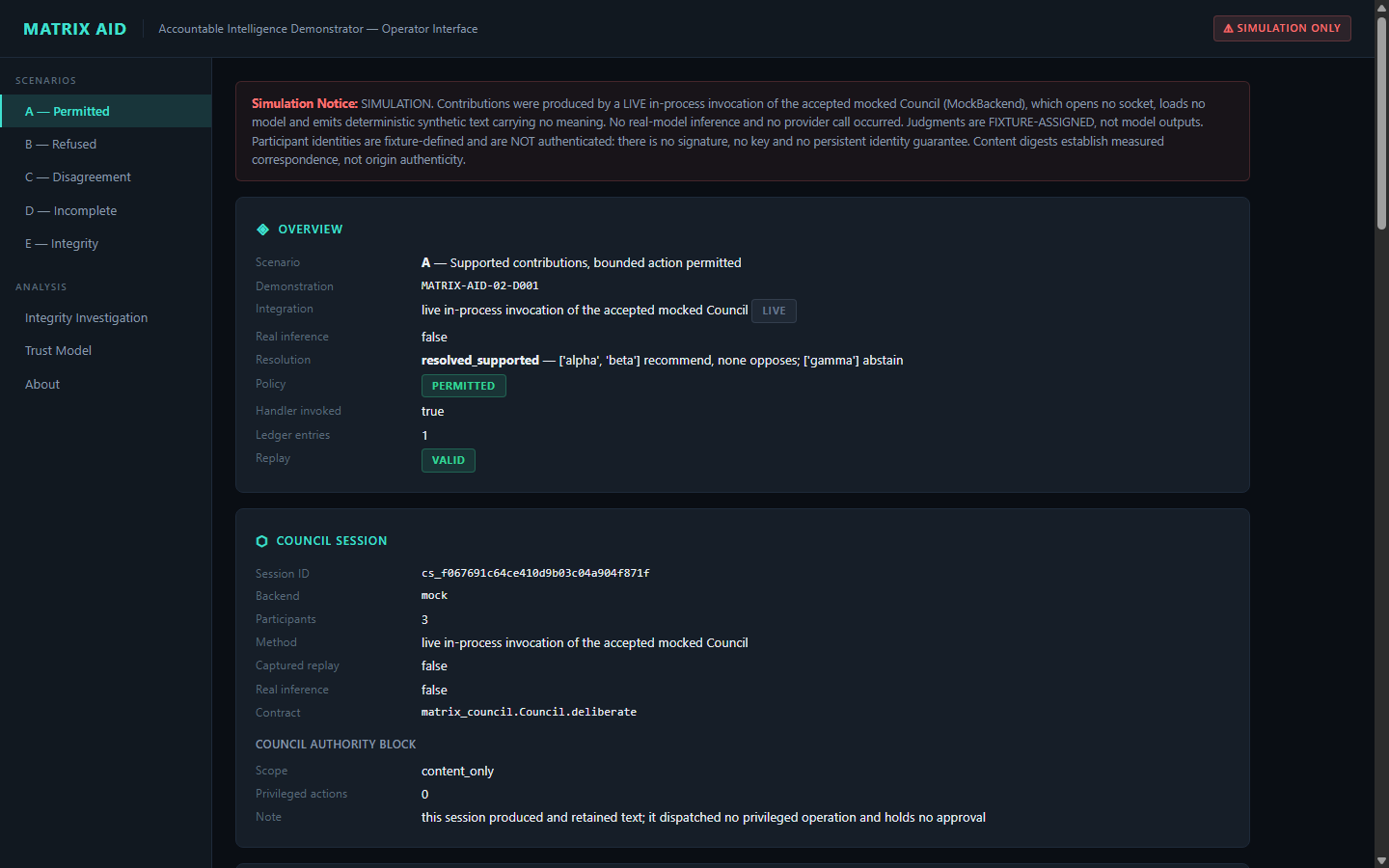
The AID is a research prototype, not a production system. It uses a simulated decision council that produces deterministic text. No real model inference occurs. All demonstration data comes from controlled scenarios, not real-world decisions. Detection rates are properties of these test scenarios, not security guarantees.
What it demonstrates
Each capability addresses a specific requirement for making AI decisions traceable and verifiable.
Three participants contribute to each decision. Each contribution is individually attributed, with provenance classification distinguishing what the model produced from what the scenario defined.
Contributions are aggregated into a resolution. Policy rules determine whether the proposed action is permitted, refused, or unresolved. The operator sees the full chain from individual contributions through to the final outcome.
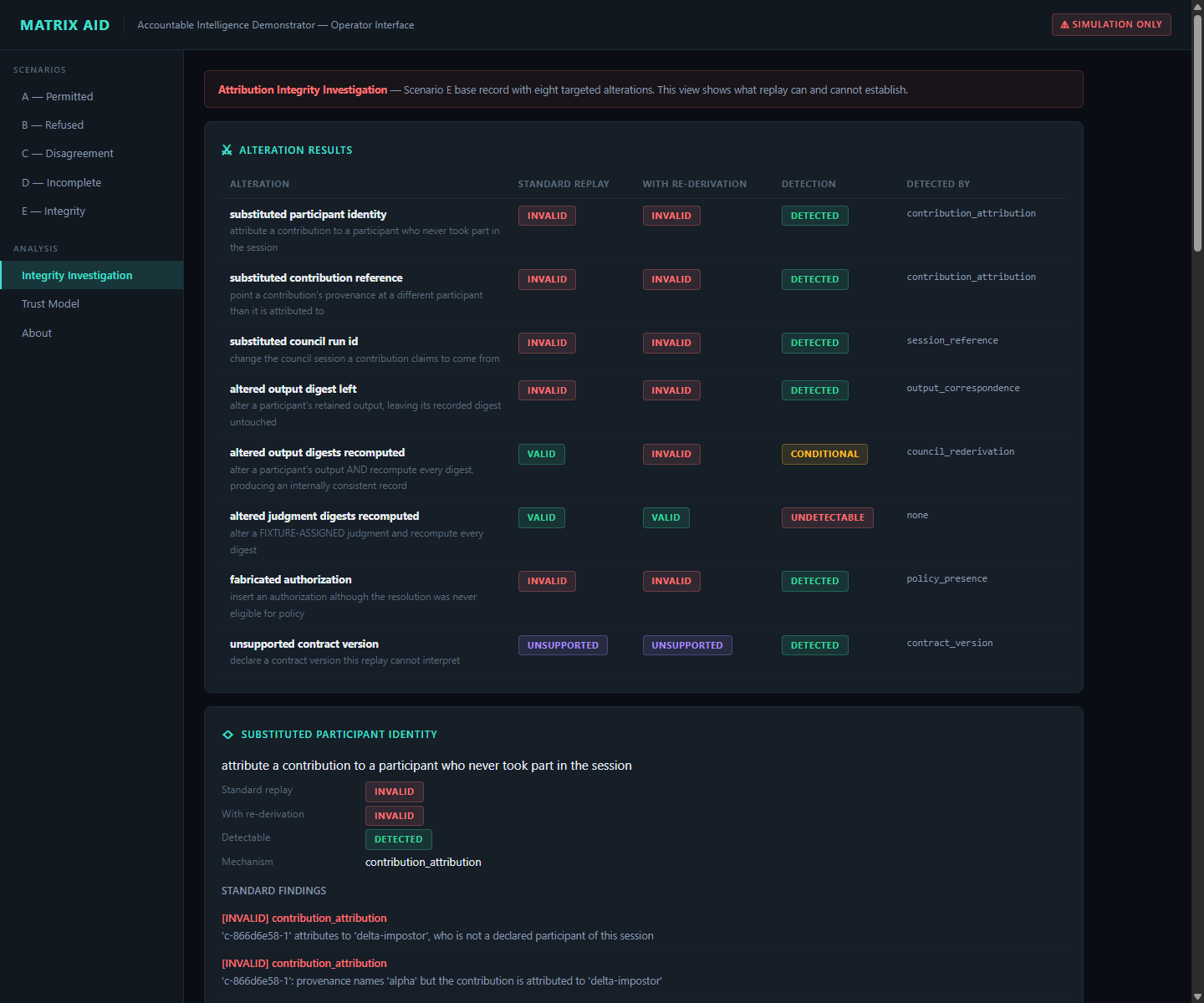
Content digests link each contribution to its source. Eight targeted alterations test whether tampering with attribution, content, or session references can be detected through replay and re-derivation.
One alteration type is explicitly marked as undetectable by current mechanisms. The demonstrator presents this honestly rather than hiding it. Knowing what you cannot detect is part of accountability.
Five scenarios
The demonstrator does not synthesize favorable results. Each scenario preserves its actual outcome.
Supported contributions, bounded action permitted. Policy: PERMITTED. Replay: VALID.
Opposition from participants triggers policy refusal. No handler invoked. Replay: VALID.
Mixed positions produce an unresolved recommendation. No action initiated. A correctly recorded disagreement is a correct record. Replay: VALID.
Unavailable evidence and a missing contribution produce genuine gaps. The record is incomplete, not failed. Replay: INCOMPLETE.
A base record subjected to eight targeted alterations. Each alteration is replayed and its detection status reported. One type remains undetectable.
INTEGRITY
The integrity investigation applies eight specific alterations to a valid record and checks whether each is detected through standard replay, council re-derivation, or both.
Seven of eight alteration types are detected. The eighth (altered fixture-assigned judgment with recomputed digests) passes both replay and re-derivation because current mechanisms cannot distinguish a correctly-formed fixture value from an altered one. This is stated as a known limitation, not hidden.
Trust model
The trust model defines what the system can and cannot verify at each level.
Schema compliance, required fields present, types correct. Established through self-test.
Content digests match, references resolve, session identifiers align. Established through replay verification.
Council outputs can be reproduced from inputs. Established for the simulated council; real-model re-derivation is a separate, unresolved problem.
Cryptographic proof that a contribution originated from a specific source. Not established; requires infrastructure not yet built.
Verifiable sequence of events across sessions. Not established.
Independent external verification of claims. Not established.
OPERATOR INTERFACE
The operator interface is a presentation layer. It renders pre-computed demonstration records but cannot modify them, invoke handlers, perform provider calls, or grant permissions. All record text is rendered through textContent, not innerHTML. The self-test suite verifies this boundary structurally.
The data bundle carries is_live_connection: false and states that it contains pre-computed results, not a live system connection.
VERIFICATION
The test suite covers data integrity, the presentation contract, scenario correctness, integrity alterations, the read-only boundary, verification states, the trust model, HTML structure, and injection safety. Five visual checks are listed as unexecuted because no browser automation environment is available. They are stated rather than fabricated.
These tests were written and run by the implementing agent, not an independent reviewer. They verify internal consistency, not external correctness. Independent acceptance is outstanding.
View research direction Development journal